Two things are true about the YAP Challenge, and they shouldn’t be able to coexist.
Jessi Jean disclosed everything. Her prior business. Her twelve years working online. Her coach. The arc of her audience — “0 to 500K+ followers” — sits right in the sales copy, Day 1 of the challenge, the headline of the offer. And a visible wave of her buyers feels deceived.
If you believe transparency builds trust, one of those facts has to be wrong. Neither is. I want to walk through why, because the answer matters far beyond one creator’s launch.
First, the stakes. The YAP Challenge is a 40-day on-camera video challenge priced at $297. The first cohort brought in $1.2 million. The second brought in over $6 million — reportedly clearing a million within the first hour — at a moment when the common wisdom said online courses were dead. I recorded a podcast episode, What Yapping Teaches Us About Trust, examining the trust architecture of this launch two days before the pushback surfaced. My argument then was that the under-credited part of the story was the groundwork: the following, the funnel experts, the coaches on tap, the beta test she ran until a participant’s video passed a million views. The groundwork was the story. It still is but the ground is shifting quickly.
Because then the criticism arrived — quieter than the word backlash implies, but pointed — and it took a strange shape. Buyers learned about the prior business and the professional support system, and some of them felt misled. One participant wrote that discovering all this made her feel a bit deceived — because everyone believed they could do the same as Jessi Jean. Her coach, Julie Chenell, went on camera to set the record straight: nothing was hidden, she’d been honest from the beginning, the receipts were always public.
And here is the detail I can’t stop turning over. Nobody disputed the receipts. Nobody accused her of lying. The grievance survived full contact with the facts, because the grievance was never about the facts. It was about who buyers believed she was.
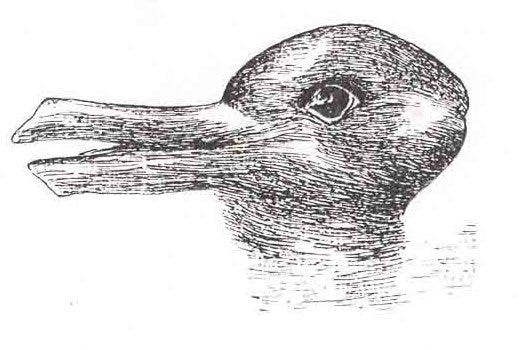
In 1892, a German humor magazine published a drawing that the psychologist Joseph Jastrow later made famous: the duck-rabbit. Look at it one way and the two long shapes on the left are a bill — you’re looking at a duck. Look again and they’re ears — the duck is gone, and a rabbit is facing the other direction. Same lines. Same ink. Nothing in the image is hidden and nothing gets added. Both animals are fully disclosed, all the time, and which one you see is decided entirely by you. You can’t see both at once.
Wikimedia Commons: File:Duck-Rabbit_illusion.jpg] Caption: The duck-rabbit. Joseph Jastrow, “The Mind’s Eye,” Popular Science Monthly, 1899; earliest version from Fliegende Blätter, 1892.
Jessi Jean’s positioning was a version of the most effective sales frame in the creator economy: I’m just like you, a bit further ahead on the journey. Except that undersells what it is. “Just like you” isn’t copywriting — it’s an identity claim, an offer of kinship. Buyers weren’t evaluating a curriculum. They were recognizing a person. And “just like you” is a duck-rabbit. Both readings are genuinely in the drawing. The rabbit: a mom in the backyard with a lav mic, no studio, talking like a normal person — like me. The duck: twelve years online, 400,000 followers, a coach on retainer, funnel experts on call. Neither reading is a mistake. She drew both animals. The frame just decides which one you see. Buyers arrived primed for the rabbit, because the rabbit is the reason they clicked.
So thousands of people looked at the same drawing and walked away certain of different animals. That’s not a flaw in the positioning. It’s the engine of it. Everyone seeing their own animal is another way of saying everyone felt personally addressed.
And look at who the drawing attracted. Beginners saw the rabbit — someone like me, proof the path is walkable — and bought kinship. But the challenge also filled with industry experts: people with businesses, audiences, and methods of their own, who enrolled precisely to watch the duck work. They wanted to see what’s working for Jessi Jean from inside the launch — the drops, the cadence, the psychology, the funnel. Same $297, same product, entirely different purchase. Both segments saw a real animal, and both got the one they saw. Which is why the discontent is so lopsided: you don’t feel deceived by a duck you enrolled to observe. The experts got exactly what they came for. The injury belongs almost entirely to the rabbit-viewers — the grievance tracks the reading, not the product.
This is why disclosure was powerless. Facts can’t flip the image, because the reading decides what the facts mean. “0 to 500K+ followers” contains both animals in a single line: to the rabbit-viewer it’s proof — look how far someone like me got — and to the duck-viewer it’s distance. Same sentence, two animals, depending on who was looking. Peers don’t get audited. And nobody questions an animal they saw with their own eyes.
The price did quiet work in the same direction. At $297, the risk feels too small to interrogate. Nobody runs due diligence on a decision that costs less than a car payment. But watch the number operate after purchase, in the threads defending the challenge against complaints about content dropping at unpredictable hours: give her a break, it’s $297 and full of useful information. The same figure that suppressed the audit going in now suppresses the grievance coming out. Low price is a two-way scrutiny discount, and it was working both directions the entire time.
Then there’s who did the defending. Not a PR team. The network. Her coach on camera. Clients in the comments, reading the defense itself as proof of character. Reddit strangers supplying charitable narratives unprompted. The challenge built its credibility by having participants post their homework publicly, distributing trust from the individual to the network she created. Now the same network runs the repair. Trust built in public gets defended in public, by the same infrastructure, without being asked. If you want to know whether trust is real, don’t ask what a company says about itself. Watch what the network does when the company is under pressure and nobody has assigned it a script.
Julie Chenell, the coach, saw a version of this coming. On July 2, more than a week before her record-straightening video, she posted that we all love the underdog until the top, and asked whether manufactured dissent had become a content strategy. She’s pointing at something real: when someone wins visibly, criticizing them becomes the differentiated move, and the feed rewards differentiation. But I’d add the part that frame leaves out. “A bit further ahead on the journey” is underdog positioning, and the second cohort’s $6 million ended it. The positioning expired and nobody announced the expiry — because the expiry outran everyone, including Jessi Jean. Her second cohort reportedly crossed a million dollars in its first hour. Identity doesn’t update on that clock. A defender on Reddit put it plainly: she never expected this to pop off. Which means the person most likely to still see the rabbit in the drawing is Jessi Jean herself. Her circumstances changed in weeks; self-image changes on a different timescale, and the gap between the two is where her buyers’ flip happened. That’s not deception. That’s lag. Some of the dissent is opportunistic. Some of it is people who saw the rabbit in good faith and watched the image flip at $6 million — and what flipped wasn’t a marketing message. It was who they thought they’d been following. The duck-rabbit doesn’t flip back on request: once you see the duck, you can’t unsee it, even though nothing in the drawing changed.
There’s one more thing I’m watching, because it’s where the real risk sits. Every defense in this story has come from somewhere other than Jessi Jean. The coach on camera. Clients in the comments. Strangers on Reddit. And well-intentioned as that network is, none of it is neutral. Julie Chenell runs a challenge of her own and a coaching practice of her own; defending her client is also, unavoidably, defending her work. That’s not an accusation — it’s a structure. The crisis communicator Molly McPherson compresses reputation response into three moves: own it, explain it, promise it. Notice what all three have in common. They can only be performed by the principal. A coach can vouch. A network can rally. Nobody can own a narrative on someone else’s behalf. As far as I can tell, there’s a conversation happening right now about who Jessi Jean is, and she isn’t guiding it. Only the person who drew the picture can say what she meant by it — and at the moment, everyone is describing the drawing except the artist. Every day that stays true, the answer belongs a little more to whoever’s speaking.
None of this makes Jessi Jean dishonest. On the evidence, she’s one of the more transparent operators in her space, and the method she sells appears to be real. That’s precisely what makes the case worth studying. Transparency is an input. Trust is an interpretation. She supplied all the information, and it protected nothing, because trust doesn’t live in the facts — it lives in the reading, and her positioning was drawn, brilliantly, to hold two animals at once. She’s also teaching what worked for her and it’s logical that many people are thinking that if you follow what worked for her, the outcomes should be the same. I haven’t heard of any challenge participant making millions of dollars yet. It’s still early - we don’t know how this story ends yet. We all know that success isn’t linear though so what’s logical versus likely is different.
Most organizations run on the same physics and never notice. The employer brand that says we’re a family. The transformation program that says nothing will change for most of you. The vendor pitch that says we’re a partner, not a supplier. Every one of those is a duck-rabbit the other party resolves privately, and every private resolution becomes a promise the institution never made but will eventually be held to. I spent seventeen years inside a financial institution large enough to watch this cycle complete itself more than once: the surprise was never in what leadership said. It was in what people heard, held onto, and produced as evidence years later.
The assumptions that come back to haunt you are almost never the ones somebody planted. They’re the ones the other party supplied and never saw themselves supplying. Which means the audit that matters happens before commitment, not after the disappointment. Finding out which animal each side is actually seeing while the drawing can still be discussed. This essentially is what I’m examining with my assumption ground audit and why I’ve been drawn to this story. For me, the story isn’t the success of the launch but how the assumptions are being laid bare and how the trust issues are playing out. It’s everyday futurism in a real-time case study.
So, a question worth sitting with, whatever you sell and whoever you lead. Your positioning is an identity you’re offering people. Look at it the way a stranger would.
Do you see a duck, or do you see a bunny? And do you know which one you drew?
For Substack paid subscribers — a few questions worth sitting with and tips to adapt the challenge for corporate.
Two things are true about the YAP Challenge, and they shouldn’t be able to coexist.
Jessi Jean disclosed everything. Her prior business. Her twelve years working online. Her coach. The arc of her audience — “0 to 500K+ followers” — sits right in the sales copy, Day 1 of the challenge, the headline of the offer. And a visible wave of her buyers feels deceived.
If you believe transparency builds trust, one of those facts has to be wrong. Neither is. I want to walk through why, because the answer matters far beyond one creator’s launch.
First, the stakes. The YAP Challenge is a 40-day on-camera video challenge priced at $297. The first cohort brought in $1.2 million. The second brought in over $6 million — reportedly clearing a million within the first hour — at a moment when the common wisdom said online courses were dead. I recorded a podcast episode, What Yapping Teaches Us About Trust, examining the trust architecture of this launch two days before the pushback surfaced. My argument then was that the under-credited part of the story was the groundwork: the following, the funnel experts, the coaches on tap, the beta test she ran until a participant’s video passed a million views. The groundwork was the story. It still is but the ground is shifting quickly.
Because then the criticism arrived — quieter than the word backlash implies, but pointed — and it took a strange shape. Buyers learned about the prior business and the professional support system, and some of them felt misled. One participant wrote that discovering all this made her feel a bit deceived — because everyone believed they could do the same as Jessi Jean. Her coach, Julie Chenell, went on camera to set the record straight: nothing was hidden, she’d been honest from the beginning, the receipts were always public.
And here is the detail I can’t stop turning over. Nobody disputed the receipts. Nobody accused her of lying. The grievance survived full contact with the facts, because the grievance was never about the facts. It was about who buyers believed she was.
In 1892, a German humor magazine published a drawing that the psychologist Joseph Jastrow later made famous: the duck-rabbit. Look at it one way and the two long shapes on the left are a bill — you’re looking at a duck. Look again and they’re ears — the duck is gone, and a rabbit is facing the other direction. Same lines. Same ink. Nothing in the image is hidden and nothing gets added. Both animals are fully disclosed, all the time, and which one you see is decided entirely by you. You can’t see both at once.
Wikimedia Commons: File:Duck-Rabbit_illusion.jpg] Caption: The duck-rabbit. Joseph Jastrow, “The Mind’s Eye,” Popular Science Monthly, 1899; earliest version from Fliegende Blätter, 1892.
Jessi Jean’s positioning was a version of the most effective sales frame in the creator economy: I’m just like you, a bit further ahead on the journey. Except that undersells what it is. “Just like you” isn’t copywriting — it’s an identity claim, an offer of kinship. Buyers weren’t evaluating a curriculum. They were recognizing a person. And “just like you” is a duck-rabbit. Both readings are genuinely in the drawing. The rabbit: a mom in the backyard with a lav mic, no studio, talking like a normal person — like me. The duck: twelve years online, 400,000 followers, a coach on retainer, funnel experts on call. Neither reading is a mistake. She drew both animals. The frame just decides which one you see. Buyers arrived primed for the rabbit, because the rabbit is the reason they clicked.
So thousands of people looked at the same drawing and walked away certain of different animals. That’s not a flaw in the positioning. It’s the engine of it. Everyone seeing their own animal is another way of saying everyone felt personally addressed.
And look at who the drawing attracted. Beginners saw the rabbit — someone like me, proof the path is walkable — and bought kinship. But the challenge also filled with industry experts: people with businesses, audiences, and methods of their own, who enrolled precisely to watch the duck work. They wanted to see what’s working for Jessi Jean from inside the launch — the drops, the cadence, the psychology, the funnel. Same $297, same product, entirely different purchase. Both segments saw a real animal, and both got the one they saw. Which is why the discontent is so lopsided: you don’t feel deceived by a duck you enrolled to observe. The experts got exactly what they came for. The injury belongs almost entirely to the rabbit-viewers — the grievance tracks the reading, not the product.
This is why disclosure was powerless. Facts can’t flip the image, because the reading decides what the facts mean. “0 to 500K+ followers” contains both animals in a single line: to the rabbit-viewer it’s proof — look how far someone like me got — and to the duck-viewer it’s distance. Same sentence, two animals, depending on who was looking. Peers don’t get audited. And nobody questions an animal they saw with their own eyes.
The price did quiet work in the same direction. At $297, the risk feels too small to interrogate. Nobody runs due diligence on a decision that costs less than a car payment. But watch the number operate after purchase, in the threads defending the challenge against complaints about content dropping at unpredictable hours: give her a break, it’s $297 and full of useful information. The same figure that suppressed the audit going in now suppresses the grievance coming out. Low price is a two-way scrutiny discount, and it was working both directions the entire time.
Then there’s who did the defending. Not a PR team. The network. Her coach on camera. Clients in the comments, reading the defense itself as proof of character. Reddit strangers supplying charitable narratives unprompted. The challenge built its credibility by having participants post their homework publicly, distributing trust from the individual to the network she created. Now the same network runs the repair. Trust built in public gets defended in public, by the same infrastructure, without being asked. If you want to know whether trust is real, don’t ask what a company says about itself. Watch what the network does when the company is under pressure and nobody has assigned it a script.
Julie Chenell, the coach, saw a version of this coming. On July 2, more than a week before her record-straightening video, she posted that we all love the underdog until the top, and asked whether manufactured dissent had become a content strategy. She’s pointing at something real: when someone wins visibly, criticizing them becomes the differentiated move, and the feed rewards differentiation. But I’d add the part that frame leaves out. “A bit further ahead on the journey” is underdog positioning, and the second cohort’s $6 million ended it. The positioning expired and nobody announced the expiry — because the expiry outran everyone, including Jessi Jean. Her second cohort reportedly crossed a million dollars in its first hour. Identity doesn’t update on that clock. A defender on Reddit put it plainly: she never expected this to pop off. Which means the person most likely to still see the rabbit in the drawing is Jessi Jean herself. Her circumstances changed in weeks; self-image changes on a different timescale, and the gap between the two is where her buyers’ flip happened. That’s not deception. That’s lag. Some of the dissent is opportunistic. Some of it is people who saw the rabbit in good faith and watched the image flip at $6 million — and what flipped wasn’t a marketing message. It was who they thought they’d been following. The duck-rabbit doesn’t flip back on request: once you see the duck, you can’t unsee it, even though nothing in the drawing changed.
There’s one more thing I’m watching, because it’s where the real risk sits. Every defense in this story has come from somewhere other than Jessi Jean. The coach on camera. Clients in the comments. Strangers on Reddit. And well-intentioned as that network is, none of it is neutral. Julie Chenell runs a challenge of her own and a coaching practice of her own; defending her client is also, unavoidably, defending her work. That’s not an accusation — it’s a structure. The crisis communicator Molly McPherson compresses reputation response into three moves: own it, explain it, promise it. Notice what all three have in common. They can only be performed by the principal. A coach can vouch. A network can rally. Nobody can own a narrative on someone else’s behalf. As far as I can tell, there’s a conversation happening right now about who Jessi Jean is, and she isn’t guiding it. Only the person who drew the picture can say what she meant by it — and at the moment, everyone is describing the drawing except the artist. Every day that stays true, the answer belongs a little more to whoever’s speaking.
None of this makes Jessi Jean dishonest. On the evidence, she’s one of the more transparent operators in her space, and the method she sells appears to be real. That’s precisely what makes the case worth studying. Transparency is an input. Trust is an interpretation. She supplied all the information, and it protected nothing, because trust doesn’t live in the facts — it lives in the reading, and her positioning was drawn, brilliantly, to hold two animals at once. She’s also teaching what worked for her and it’s logical that many people are thinking that if you follow what worked for her, the outcomes should be the same. I haven’t heard of any challenge participant making millions of dollars yet. It’s still early - we don’t know how this story ends yet. We all know that success isn’t linear though so what’s logical versus likely is different.
Most organizations run on the same physics and never notice. The employer brand that says we’re a family. The transformation program that says nothing will change for most of you. The vendor pitch that says we’re a partner, not a supplier. Every one of those is a duck-rabbit the other party resolves privately, and every private resolution becomes a promise the institution never made but will eventually be held to. I spent seventeen years inside a financial institution large enough to watch this cycle complete itself more than once: the surprise was never in what leadership said. It was in what people heard, held onto, and produced as evidence years later.
The assumptions that come back to haunt you are almost never the ones somebody planted. They’re the ones the other party supplied and never saw themselves supplying. Which means the audit that matters happens before commitment, not after the disappointment. Finding out which animal each side is actually seeing while the drawing can still be discussed. This essentially is what I’m examining with my assumption ground audit and why I’ve been drawn to this story. For me, the story isn’t the success of the launch but how the assumptions are being laid bare and how the trust issues are playing out. It’s everyday futurism in a real-time case study.
So, a question worth sitting with, whatever you sell and whoever you lead. Your positioning is an identity you’re offering people. Look at it the way a stranger would.
Do you see a duck, or do you see a bunny? And do you know which one you drew?
For Substack paid subscribers — a few questions worth sitting with and tips to adapt the challenge for corporate.
This is the part where I’d normally hand you a framework. Instead, sit with these. They’re the questions I’d ask if we were looking at your drawing together.
What identity is your positioning offering? Not your value proposition — the person or institution people believe they’re dealing with. If a stranger described it back to you, would you recognize it?
What are the two animals in your drawing? Every positioning strong enough to attract people holds more than one reading. What does a newcomer see? What does an insider see? If you can only name one animal, you haven’t looked long enough — the other one is still in there.
What have you disclosed and assumed was therefore understood? Disclosure is what you put in the drawing. Understanding is what people see in it. List the facts you consider “on the record” and ask, honestly, which reading each one supports.
What does your price tell people about how carefully to look? Low prices suppress scrutiny in both directions — before the decision and after the complaint. Whatever you charge, your buyers’ level of examination is calibrated to it. Is that the level of examination you want your offer to receive?
What has changed faster than your self-image? Jessi Jean’s circumstances moved in weeks; identity moves on a different timescale. What’s true about your position now that your positioning hasn’t caught up to — growth, credibility, scale, distance from the people you started alongside?
If you were publicly criticized tomorrow, who would defend you unprompted? Not who you’d call. Who would show up without being asked. That answer tells you where your trust actually lives — and whether you’ve built anything that lives outside your own account. One caution, though: defense from your network is an asset, not a substitute. Nobody can own your narrative on your behalf.
None of these have quick answers. That’s rather the point: the reading each person carries of you was formed slowly and privately, and it only gets examined the same way — deliberately, before the moment that would otherwise examine it for you.
And if you’re thinking about running a version of this inside your organization
I said on the podcast that a challenge like this could be repurposed as a corporate initiative, and I still think it’s one of the more interesting low-cost experiments available right now. Some of your employees are probably already in the YAP Challenge on their own time and their own dime. The question is whether the organization benefits from the skills they’re building anyway. If you’re going to try it, the case we just walked through is your instruction manual — including the parts that went sideways.
Sponsor it in the open. The signal isn’t the skill development; it’s that the company invested in its people during an uncertain stretch. A quiet pilot wastes the trust value. Say what you’re running and why.
Pick the venue deliberately, and let people graduate. Public on LinkedIn builds employer brand — prospective hires and clients watching real employees show up authentically is worth more than any careers page. Private on Slack builds safety. You can start private and surface the strongest work publicly later, with permission. What you can’t do is be vague about which one people signed up for.
Don’t script the thing that works. Employees are more trusted than executives precisely because they sound unmanaged. The moment communications polishes the posts, you’ve removed the ingredient you were trying to buy. Set guardrails on topics if you must; leave the voice alone.
Name both animals before anyone opts in. This is the lesson from the whole episode. Say what the challenge is — presence, point of view, on-camera confidence — and what it is not: a promise of virality, a promotion track, a performance review input. Every unstated expectation you leave open, someone will fill in privately and hold you to later.
Keep the cadence boring. The loudest operational complaint about the original challenge was drops arriving anywhere from morning to midnight. Inside an organization that’s fatal — unpredictability reads as disrespect for people’s time. Whatever rhythm you promise, keep it exactly.
Let the network carry the proof. The genius of the original design was participants watching each other improve in their own feeds. Recreate that loop internally: visible work, visible progress, peers as the credibility engine. And pay attention to who participates and defends the experiment unprompted — that’s a live map of where trust actually sits in your organization, and you couldn’t buy that data any other way.